
No Victory Lap. Coach Beard Brought 15 More Books.
Oct 09, 2026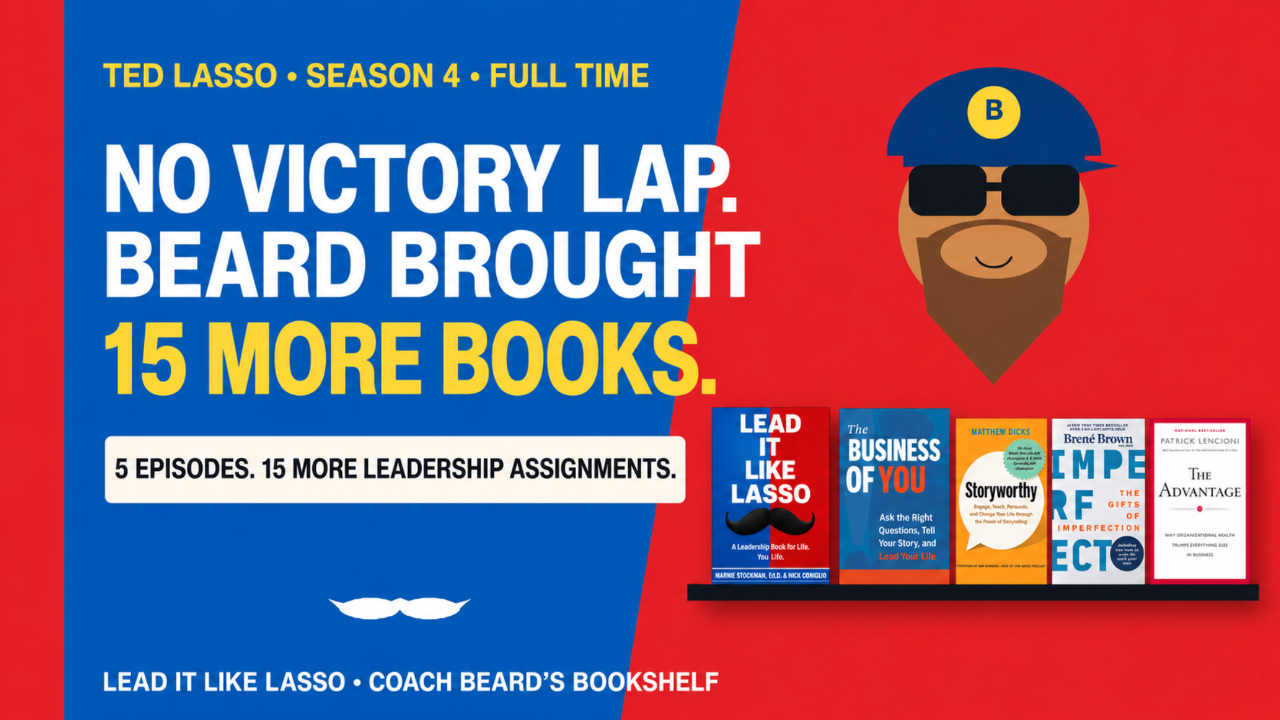
A full-time reading list for the second half of Ted Lasso Season 4
Spoilers through Season 4, Episode 10. Also, the bookshelf is now a structural concern.
At halftime, Coach Beard had sixteen books.
One might reasonably assume that would be enough reading material for a five-episode stretch of television. One would not understand Coach Beard.
The second half of Season 4 brought change, fear, anger, old injuries, new roles, difficult goodbyes and several people discovering that “I’m fine” is not a particularly convincing leadership strategy when said through tears.
It also gave us wonderfully inconvenient questions.
When does helping become taking over? How do leaders support people without solving everything for them? Can someone change the way they work without losing what makes them special? What happens to a culture when the person who shaped it leaves? And how many leadership books can one fictional football coach carry before someone from workplace safety gets involved?
We went back through Episodes 6–10 and our Lead It Like Lasso podcast conversations to finish Beard’s Season 4 reading list.
Fifteen books. Five episodes. One shelf that now requires professional reinforcement.
As with the halftime list, these are not generic leadership books dropped beside an episode because both contain the word “team.” Each one belongs to a specific tension, character or moment.
Find the one that feels mildly accusatory. That is probably your book.
Episode 6: Perfect can be the opposite of good
Episode 6 puts several people in familiar traps.
Someone wants to get everything exactly right before moving. Someone else rushes toward a solution before fully understanding the problem. Meanwhile, Zelda’s guest list reminds us that gathering people together and creating a meaningful gathering are two entirely different skills.
Conveniently, Beard has read about all three.
The Gifts of Imperfection by Brené Brown
Who should read it: The person waiting to feel completely prepared, confident and emotionally organized before doing the thing.
Perfectionism often arrives dressed as a high standard. It sounds responsible. It owns excellent notebooks.
It can also keep us from starting, asking for help or letting anyone see the part that is still in progress.
Brown’s work gives us a more useful target than perfection: showing up honestly and allowing ourselves to be seen before every rough edge has been sanded away.
Season 4 keeps reminding us that people do not become ready in private and then emerge fully formed. They become ready through participation, mistakes, feedback and the occasional decision they would prefer not to discuss again.
Beard’s margin note: Perfect has excellent manners. It will politely keep you from ever beginning.
The Advice Trap by Michael Bungay Stanier
Who should read it: The helpful person who has already built a four-step solution while everyone else is still explaining the problem.
Gemma’s instinct to help comes from care. That is what makes the advice trap so sneaky.
Giving an answer feels useful. It also gives the advice-giver a clear role, a quick hit of competence and something to do with the discomfort of watching another person struggle.
The problem is that our solution may be built for the wrong problem. Even when it is right, handing it over too quickly can keep someone from developing their own judgment.
Support sometimes sounds like advice. Other times, it sounds like, “What do you think you should do?” Or even, “Would you like my opinion, or do you need me to stay here while you work through it?”
Beard’s margin note: Before fixing the problem, make sure the problem belongs to you.
The Art of Gathering by Priya Parker
Who should read it: The host with a detailed guest list, excellent snacks and no answer to why everyone is there.
Zelda’s guest list gives us an opening to talk about something most leaders underestimate: a gathering needs a purpose stronger than the calendar invitation.
Parker argues that meaningful gatherings are designed around a reason. Who belongs in the room, what they are being invited to do and what should be different when they leave all flow from that purpose.
The same applies to team meetings, retreats and every offsite that has ever included an icebreaker somebody found online at 11:53 the previous evening.
Bringing people together is logistics. Helping them connect, decide, celebrate or change requires design.
Beard’s margin note: Attendance tells you who came. Purpose tells you whether the gathering mattered.
Episode 7: “Yes” is generous. “Yes, and” is leadership.
Alice begins “Yes & Baby” by saying yes to everything.
This goes about as well as it usually does.
Ted introduces the improv principle of “Yes, and.” The difference is one small word and an entirely different leadership posture.
Yes accepts what is in front of us. And asks us to contribute something useful.
The episode also gives Ted a question that stops many perfectly capable people in their tracks: Tell me about yourself.
Beard brought three books. One helps us build on what others offer. One helps us understand the person behind our résumé. The third asks what leaders must provide before expecting people to perform.
Yes, And by Kelly Leonard and Tom Yorton
Who should read it: The collaborative leader whose current strategy is either agreeing with everything or explaining why nothing will work.
Alice discovers that saying yes to every request is not collaboration. It is surrender with a pleasant expression.
“Yes, and” asks more of us. We have to accept the reality or idea someone has placed in the room, then add something that moves it forward.
That does not mean every idea survives. It means people experience the conversation as a shared construction project rather than an audition for the leader’s approval.
This is part of what makes Ted’s coaching distinctive. He rarely treats another person’s contribution as the finished answer or as something to dismiss. He picks it up, turns it around and looks for what it could become.
Beard’s margin note: Yes opens the door. And gives everyone something useful to do once they are inside.
The Business of You by Marnie Stockman and Nick Coniglio
Who should read it: The accomplished person who answers “Tell me about yourself” with a chronological list of job titles.
Yes, we put another one of our books on Beard’s shelf. Ted filled out the request form this time.
Knowing the facts of your life is not the same as knowing the story they tell.
Most of us can list where we worked, what we studied and the responsibilities we have collected. We have a harder time explaining what those experiences reveal about us: the patterns, strengths, values and evidence that help another person understand who we are.
Ted has spent years helping other people see themselves differently. When the attention turns toward him, the words become harder to find.
That is not unusual. Self-awareness requires more than looking inward. Sometimes we need another person to hold up a more honest mirror.
Beard’s margin note: Your résumé records where you have been. Your story explains what you carry forward.
Leaders Eat Last by Simon Sinek
Who should read it: The leader asking for peak performance while the team is still looking for safety, clarity and basic support.
Belief matters. So do the conditions that let people turn belief into good work.
Sinek’s central idea is that leaders create an environment in which people feel protected enough to contribute, take risks and look after one another. That protection does not mean removing every difficult task or uncomfortable conversation. It means people trust that the leader is not asking them to absorb all the risk while management enjoys the motivational poster.
Beard is often the person providing practical support while someone else delivers the speech. Teams need both.
Inspiring people without giving them what they need is not leadership. It is optimism with an expense account.
Beard’s margin note: Before asking people to reach higher, check whether the floor is holding.
Episode 8: Follow the anger. Do not let it drive.
Mae tells Higgins to follow the anger.
It is excellent advice, provided we understand that following anger does not mean giving it the car keys and asking it to choose the music.
Anger, fear and frustration can reveal something important. They may point toward a crossed boundary, a threatened value, an old wound or a problem everyone has been politely stepping around.
Episode 8 also gives us a tree-nut basket for a player with a tree-nut allergy, a coach insisting she is fine while clearly not being fine, and Ted reminding everyone that there is, in fact, crying in football.
Beard’s shelf got specific.
Triggers by Marshall Goldsmith
Who should read it: The person whose pet peeve has started making decisions on their behalf.
Goldsmith’s work examines the moments that pull us toward familiar reactions.
The useful move is not pretending we are above being triggered. It is learning to notice what is happening early enough to choose what comes next.
Mae’s “follow the anger” advice works because anger contains information. It may tell us that fairness matters, that responsibility has been avoided or that we are more frightened than we want to admit.
The feeling deserves attention. It does not automatically deserve authority.
Beard’s margin note: Anger is data. Let it identify the problem before it volunteers to become the solution.
The Advantage by Patrick Lencioni
Who should read it: The leadership team whose values look excellent on the website and suspiciously absent on an ordinary Tuesday.
A tree-nut basket sent to someone with a tree-nut allergy is funny until we consider what it says.
Somebody completed the task. Nobody paid enough attention to the person.
Organizational health lives in those small moments. Does information move? Can people say they are struggling? Do leaders notice when the official process creates an absurd result? Does anyone feel responsible for questioning it?
Lencioni argues that healthy organizations create clarity, communicate it repeatedly and build systems that reinforce it. Culture becomes credible when the daily experience matches what the organization claims to value.
A personalized note cannot rescue a gift that might send the recipient to the hospital.
Beard’s margin note: Culture shows up in what people notice before they click send.
Storyworthy by Matthew Dicks
Who should read it: The leader who keeps asking for honesty while offering facts, updates and absolutely no humanity. (Actually, Marnie would say everyone should read it.)
We included Storyworthy in the first-half list, and it has returned. Some books earn another match.
Stories help people make sense of what happened and why it matters. They give emotion somewhere to go.
Ted’s willingness to talk honestly about embarrassment, fear and failure gives other people permission to name their own experiences. In Episode 8, he also makes room for crying instead of treating it as a malfunction that must be stopped before the next drill.
A story does not make the difficult thing disappear. It can make the person living through it feel less isolated.
Beard’s margin note: Facts explain the event. Stories help people understand what the event did to them.
Episode 9: Stop thinking. Start trusting.
Episode 9 asks several characters to reconsider what strength looks like.
Boots has to adapt without abandoning the instincts that make her special. Gemma has to decide whether continuing to push is commitment or refusal to listen. Mae rides the team bus and reminds Richmond that influence has never required a place on the official organizational chart.
This is the episode where legacy, rethinking and grit all need to share one shelf.
Lead It Like Lasso by Marnie Stockman and Nick Coniglio
Who should read it: The person who assumes their legacy will be measured by their title, office or number of people required to attend their meetings.
Mae is not a coach, player or sports psychologist.
She is also the person carrying Richmond’s history and reminding the team why the club matters.
That is legacy. It lives in what people remember, repeat and continue after we have left the room.
In Lead It Like Lasso, we ask readers to consider what they want people to say about how they led when their time is done. Writing that ending gives us something to lead toward now.
Mae has spent years shaping Richmond without needing her name on the team sheet.
Beard’s margin note: Legacy is what still guides people after your chair is empty.
Think Again by Adam Grant
Who should read it: The expert who worries that changing the method will erase what made them successful.
Boots does not need to become a different goalkeeper. She needs to question one assumption: that adapting means giving up what makes her special.
Grant’s work gives us language for intellectual flexibility. Strong thinkers can update an idea without treating the update as a personal defeat.
That matters because experience can become identity. A technique, habit or belief that once helped us succeed begins to feel inseparable from who we are.
Rethinking lets us keep the instinct while updating the method.
Beard’s margin note: Changing your mind does not require changing your name.
Grit by Angela Duckworth
Who should read it: The determined person who has begun treating every warning sign as a character test.
Gemma wants to keep going. Her knee is contributing a strongly worded dissent.
Grit is passion and perseverance over time. It is not endless motion regardless of cost, evidence or medical advice.
Sustainable perseverance requires judgment. Sometimes commitment means pushing through discomfort. Sometimes it means recovering, changing the plan or stepping away long enough to protect the larger goal.
Rest is not always the opposite of grit. Occasionally it is the reason grit survives.
Beard’s margin note: Staying in the game may require knowing when to step out of it.
Episode 10: Build something that keeps moving when you leave
The finale contains enough change to make an organizational chart quietly request personal leave.
Roy is returning home. New leaders are stepping forward. Ted’s coaching tree continues to grow. Mae’s influence remains woven into Richmond. Rebecca rewrites an old story. Alice joins the Diamond Dogs as their first Cat Person.
The team, like the people inside it, is still becoming.
Then the episode hands us the line that may summarize the season:
“We laugh, we hurt, we fall, we get back up. We’re a mess.”
Being messy just means being alive.
Beard’s final three books look at succession, change and the creative work required to make any of this exist.
Good to Great by Jim Collins
Who should read it: The leader who has built something impressive and accidentally made themselves essential to all of it.
Ted’s coaching tree is getting crowded.
That is a job well done.
Great leaders grow people who are capable of leaving, prepare others to step forward and create a culture that can survive the handoff.
This is one of leadership’s stranger tensions. We invest in people knowing they may eventually take what they learned somewhere else. We build systems that should function without our constant presence. We celebrate when someone becomes ready for a role we would rather not watch them leave to accept.
The test is not whether people still need us. It is whether our influence continues to help them when they do not.
Beard’s margin note: Your influence should outlast your presence.
Leadersheep: Saving the Herd by Dr. Mary Lippitt
Who should read it: The change leader who made the announcement and is now wondering why everyone has additional questions.
Almost everyone in the finale is moving toward something new.
Change rarely fails because nobody mentioned it. It struggles because people do not understand what is shifting, why it matters, what is expected or where they fit once the dust settles.
Leadersheep uses a fable to explore the practical work of executing change. Vision matters, but people also need clarity, capability, resources and enough confidence to take the next step.
Moving the herd takes more than pointing dramatically toward the horizon.
Beard’s margin note: Announcing the destination is not the same as helping people make the trip.
The War of Art by Steven Pressfield
Who should read it: The person waiting for inspiration to arrive before beginning the creative work.
Four seasons of Ted Lasso did not appear because creativity felt easy every day.
The writers returned to the blank page, the difficult rewrite, the idea that failed and the risk of trying something new. They built callbacks across seasons, gave old characters new choices and attempted to finish a story people cared about without simply repeating what had worked before.
Pressfield calls the force that pushes against creative work Resistance. It appears as procrastination, perfectionism, distraction and the sudden conviction that reorganizing a desk is urgent.
The work gets made because someone returns anyway.
This book is our thank-you to the people who kept returning.
Beard’s margin note: Inspiration is welcome. Showing up has a more reliable attendance record.
The full-time speech
If Coach Beard were assigning all fifteen books at once, even he would have to acknowledge that the season is over and people have luggage allowances.
He would probably choose the book that belongs to the moment.
If perfection has kept you safely preparing, start with The Gifts of Imperfection.
If helping has become a reflex that removes everyone else’s chance to think, open The Advice Trap.
If your meetings have excellent catering and no discernible purpose, try The Art of Gathering.
If collaboration has become an endless exchange of yeses or nos, add the and with Yes, And.
If you can list your accomplishments but cannot explain who you are, we know two authors who wrote The Business of You.
If anger keeps arriving before your better judgment, let Triggers help you follow the information without following it off a cliff.
If the culture people experience does not resemble the one described in orientation, The Advantage is waiting.
If changing the method feels like betraying your identity, Think Again.
If your grit has stopped listening to evidence, read Grit. Preferably while sitting down.
If the organization cannot function without you, Good to Great may be less comfortable than you hoped.
If you announced a change and assumed the hard part was finished, please report to Leadersheep.
And if you have been waiting for the perfect moment to make something, The War of Art would like a word.
The first half of Season 4 asked how leaders build belief, trust and a team.
The second half asks what happens next.
People grow. Roles change. Someone leaves. Someone else steps forward. The culture either carries what mattered or reveals that it only worked while one particular person was standing in the room.
Leadership is not complete when people follow us.
Some of its best work appears when they are ready to continue without us.
Fifteen more books. Ten episodes complete. One final question:
Which book belongs on your full-time reading list?
Listen and keep reading
Our second-half Season 4 conversations:
Lead It Like Lasso is an unofficial, unauthorized leadership project inspired by the ideas and characters of the series. It is not affiliated with Apple TV+, Warner Bros. Television or the creators of Ted Lasso.
Stay connected with news and updates!
Join our mailing list to receive the latest news and updates from our team.
Don't worry, your information will not be shared.
We hate SPAM. We will never sell your information, for any reason.
