
No Orange Slices. Coach Beard Brought 16 Books.
Sep 08, 2026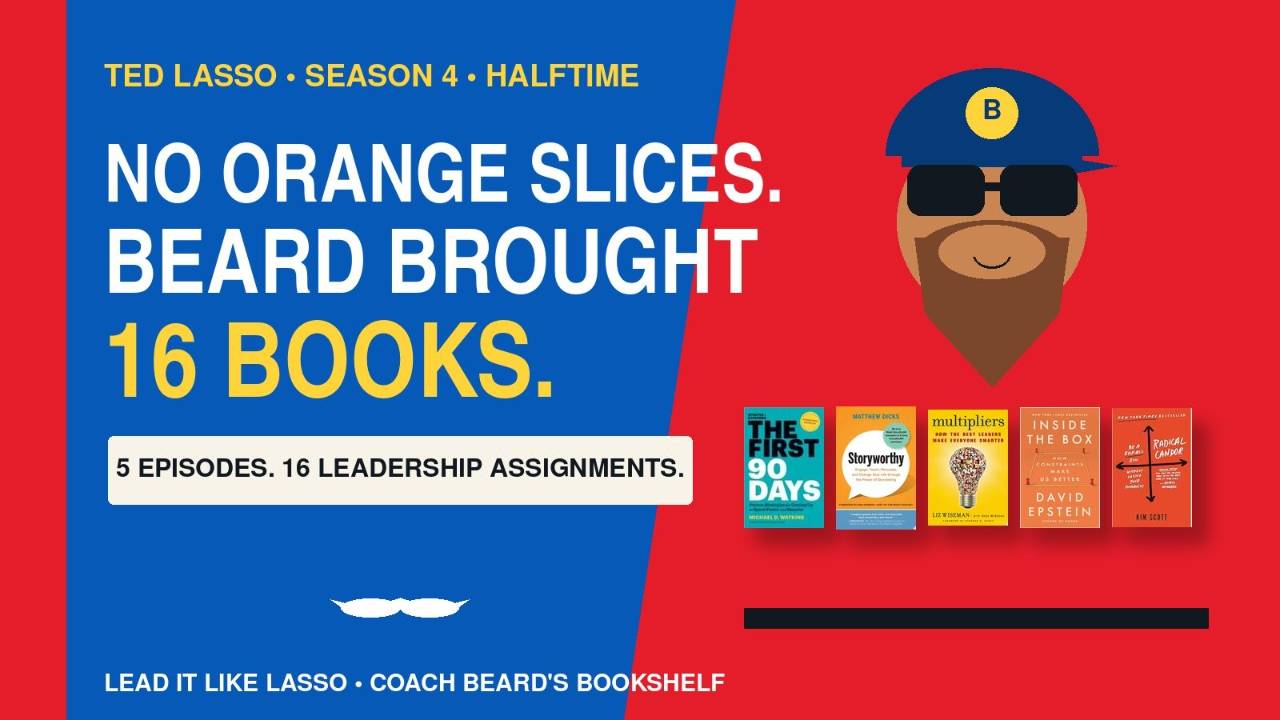
A halftime reading list for the first five episodes of Ted Lasso Season 4
Spoilers through Season 4, Episode 5. Also, several books may follow you home.
We are five episodes into a ten-episode season, which makes this halftime.
In football, halftime usually brings water, adjustments, and a speech delivered at a volume that suggests the whiteboard has been personally disappointing. At AFC Richmond, we imagine Coach Beard quietly rolling in a bookshelf behind Ted's brilliant stories.
That feels more useful anyway.
The first half of Season 4 has asked some wonderfully inconvenient leadership questions. What happens when an experienced leader knows the organization but not the team? When does belief develop talent, and when does it look like favoritism? How do we give direct feedback without making people wish they had called in sick? Can a team-building exercise be successful if it technically ends in jail?
We went back through the first five episodes and our Lead It Like Lasso podcast conversations to build Beard's halftime reading list: sixteen books, five episodes, and one very crowded nightstand.
This is not a list of books that happen to contain the word leadership. Each one belongs to a particular person in the Richmond universe and to one of us in real life. Find your archetype. Accept your assignment. Audiobooks count.
Episode 1: You can come home and still be the new person
Ted returns to Richmond with history, affection, and considerably more Premier League experience than he had the first time. He also returns to a team he has never coached.
That distinction matters. Familiar logo. Familiar hallway. Unfamiliar people.
Experience can make a leader useful on day one. It can also make us dangerously certain by lunch.
The First 90 Days by Michael D. Watkins
Who should read it: The returning expert who already has a color-coded plan. (The tabs are excellent. Nobody asked.)
Watkins writes about the particular work of entering a new role: learning the landscape, building credibility, and resisting the urge to apply an old answer before understanding the new question. Ted knows Richmond. He does not yet know this Richmond team.
Keep what works from your experience. Just hold it loosely enough that the people in front of you can update it.
Beard's margin note: Experience gives you a map. Curiosity tells you whether the roads moved.
The Culture Code by Daniel Coyle
Who should read it: The leader who reaches for a mission statement when the room is still deciding whether to trust them.
Rebecca does not bring Ted back because the women's team needs a prettier set of values on the wall. She brings him back because she watched him change what it felt like to be at Richmond.
Culture is built in hundreds of moments too small for the annual report: who gets asked a question, who gets interrupted, what happens after a mistake, whether the boss remembers the thing you mentioned three Tuesdays ago. Ted's methods can look unserious if you inventory them one at a time. Together, they tell people, You matter here.
Beard's margin note: Culture rarely arrives as a speech. It sneaks in through the moments people decide to trust.
Essentialism by Greg McKeown
Who should read it: The Keeley-shaped visionary whose idea board now requires its own idea board.
Keeley has imagination, energy, stadium-sized ambition, and enough possible initiatives to keep three marketing departments politely panicked. What she struggles to name is what exists outside the work and which idea matters most now.
That is the trap McKeown helps us see. Busyness can look exactly like commitment from across the room. Up close, it may be a refusal to choose.
Focus gives the best idea enough oxygen to become real.
Beard's margin note: A full calendar can still be an empty strategy.
Episode 2: A résumé gets one page. A person does not.
Episode 2 keeps placing labels in front of Ted and watching him look around them.
Boots comes labeled as the goalkeeper who refuses gloves. Alice arrives with “difficult” already stuck to her file. Ted is still “the American coach.” Higgins has numbers that say the women's team should not exist; Ted wonders what story the team might write next.
The numbers matter. So does the part of the person that did not fit in the cell.
The Coaching Habit by Michael Bungay Stanier
Who should read it: The helpful fixer who begins answering while everyone else is still inhaling.
Ted's curiosity is sometimes mistaken for whimsy. It is actually reconnaissance. He asks questions other leaders dismiss as irrelevant because the answers tell him how people see themselves, what they protect, and what they might do next.
Bungay Stanier's central coaching discipline is deceptively difficult: say less and ask more. That means tolerating the two full seconds in which you know the answer and do not release it into the room like a golden retriever carrying a shoe.
Beard's margin note: Curiosity gathers evidence judgment misses.
Storyworthy by Matthew Dicks
Who should read it: The spreadsheet loyalist who knows what happened and cannot explain why.
On our podcast, we kept returning to one line: stats tell you what; stories tell you why.
A report can show that a team costs money. It cannot tell you what the team could mean to the club, the city, or a player who has been waiting for a real chance. A résumé can list injuries, seasons, and positions. It cannot tell you what those experiences taught someone to fear or fight for.
Stories give facts a pulse.
Beard's margin note: If the data has surprised you, go meet the person who generated it.
Dare to Lead by Brené Brown
Who should read it: The bubble-wrap boss who has confused safety with the absence of discomfort.
Boots prefers the sting of the ball against her hands. We are not recommending this as goalkeeper instruction. We are interested in the reason: the sting makes the experience real.
Good leaders protect people from humiliation, retaliation, and reckless harm. They cannot protect people from every awkward question, difficult rep, or honest conversation without also protecting them from growth.
Brown's work makes room for that distinction. Psychological safety does not promise a sting-free day. It gives people confidence that a hard moment will not cost them their dignity or their place on the team.
Beard's margin note: Build a room where discomfort can do useful work.
Episode 3: Belief is powerful. It also needs adult supervision.
Richmond needs a striker. Ted sees something in Shannon that the available evidence does not. Alice sees favoritism. Both have a point.
Belief can give someone the first chance their record has not yet earned. It can also become a halo that protects our favorite person from the standards everyone else must meet. The episode is smart enough to leave us with both problems.
Leadership lives in the space between those two possibilities. Annoying, but there it is.
Multipliers by Liz Wiseman
Who should read it: The talent spotter who can see a future version of someone before everyone else has finished reading the past one.
Wiseman distinguishes leaders who amplify other people's intelligence and capability from those who keep proving that the smartest person in the room has their job title.
Ted is at his best when his belief creates a stage on which someone else can show what they can do. The important word is show. Offer the chance, add support, and leave enough room for the person to produce new evidence.
Beard's margin note: Spot the talent. Then hand it the ball.
Switch by Chip Heath and Dan Heath
Who should read it: The change champion with an inspiring vision and no kits.
The women's team is not short on ambition. It is short on several of the less cinematic ingredients of change: resources, clear plans, aligned incentives, and shared confidence that the machinery will work.
This is where transformation decks become dangerous. A leader can make the destination sound thrilling while everyone else is still trying to locate the bus.
The Heath brothers write about making change possible for both the rational and emotional parts of us, then shaping the path so good intentions have somewhere to go. Richmond's new team needs all three. Purpose matters. So do clean uniforms.
Beard's margin note: If your change plan depends on everyone improvising brilliantly, you have written a wish.
The Fearless Organization by Amy C. Edmondson
Who should read it: The leader whose team never seems to get a friendly.
Keeley makes a sharp observation: women are often denied the low-stakes rehearsal. They succeed publicly or fail publicly, while someone else gets a developmental season and a patient explanation of their potential.
Edmondson's work on psychological safety helps explain why that matters. Learning requires questions, unfinished ideas, experiments, and recoverable mistakes. If every attempt feels like a final exam, people spend their energy looking competent instead of becoming more capable.
Keep the standards high and build enough runway to reach them.
Beard's margin note: If people only get one chance to be good, they will spend it trying not to look bad.
Episode 4: Constraints, moonshots, facts, and one very committed team
Episode 4 has enough leadership material to make Coach Beard check the structural integrity of the shelf.
Rebecca tells Keeley no. Keeley promises to sell out Nelson Road. The team has to believe in an audacious goal without becoming allergic to arithmetic. And an exercise intended to build cohesion ends with the sort of venue change no facilitator puts in the brochure.
Four books. It was that kind of week.
Inside the Box by David Epstein
Who should read it: The idea person who has just hit a wall.
Rebecca's no gives Keeley something useful: resistance. A wall only says stop. A useful constraint asks, Not that way. What else have you got?
The limit becomes part of the creative brief. Keeley has to stop polishing the first route and find a better one.
Beard's margin note: Sometimes the box is where the interesting work starts.
Built to Last by Jim Collins and Jerry I. Porras
Who should read it: The big-promise maker who has just told Rebecca they will sell out Nelson Road.
The book gave business language a memorable acronym for the kind of target Keeley names: a BHAG, or big, hairy, audacious goal. The useful part is not that the goal sounds bold in a meeting. It is that everyone can see the finish line and begin making different decisions because it exists.
Beard's margin note: A BHAG needs more than optimism in a louder blazer.
Good to Great by Jim Collins
Who should read it: The believer who avoids the spreadsheet and the skeptic who uses it as a hiding place.
Richmond needs faith and facts in the same conversation. Faith without facts becomes a poster. Facts without faith become a beautifully researched reason not to try.
Holding confidence in the outcome while confronting the ugliest current reality is hard. That is also why it is leadership rather than positive thinking with office supplies.
Beard's margin note: Keep the belief. Bring the receipts.
The Dichotomy of Leadership by Jocko Willink and Leif Babin
Who should read it: The culture builder whose team will follow them anywhere. Apparently including jail.
Team building is often dismissed as fluff. Episode 4 argues that shared experience matters, then adds a fairly important footnote: cohesion is an accelerant, not a moral compass.
A bonded team can produce a brilliant result. It can also execute a terrible decision with impressive coordination. Leaders have to create belonging and remain willing to interrupt the group when the group is wrong.
Beard's margin note: Together can still be wrong.
Episode 5: Make it safer to fail, then keep the standard
Episode 5 gives us a leadership move Ted performs better than almost anyone: he goes first.
Before asking a locker room to be honest about embarrassment, Ted talks about his own. He gives the team evidence that vulnerability will not be punished. Later, he also gives Alice direct feedback and a consequence.
Warmth and standards share the same locker room. Neither gets to borrow the other's kit.
Radical Candor by Kim Scott
Who should read it: The honest leader everyone braces for.
Alice has the “challenge directly” half well covered. The harder question is whether the team experiences the care beneath it.
Feedback does not become more useful because it is technically accurate. People need to understand that the challenge is for them, not merely aimed at them. Candor without care is often just criticism wearing a management lanyard.
Beard's margin note: People can feel the difference between receiving truth and having it thrown at them.
Right Kind of Wrong by Amy C. Edmondson
Who should read it: The leader paying tuition for the same mistake twice.
Ted recognizes a pattern from his experience with Nate and makes a different choice with Alice. Learning from failure does not require us to celebrate the mistake or pretend the damage was delightful. It asks us to extract the information and change the next decision.
Failure is expensive feedback. We may as well open the envelope.
Beard's margin note: A mistake becomes tuition only when the next move changes.
Lead It Like Lasso by Marnie Stockman and Nick Coniglio
Who should read it: The kind leader who worries that a boundary will make them less kind.
Yes, we put our own book on Beard's shelf. This episode practically filled out the request form.
Ted demonstrates vulnerability before asking for it. He coaches with patience, names what is unacceptable, and acts when a boundary is crossed. That combination is the heart of the leadership we explore in Lead It Like Lasso: people-first leaders still hold the standard.
Beard's margin note: Kindness needs a backbone, or it becomes avoidance with excellent manners.
The halftime speech
If Coach Beard were handing out these books in the locker room, we doubt he would assign all sixteen before the second half. That is how you lose a room and possibly a small claims case involving a nightstand.
He would probably look at the team, identify the tension each person is living, and hand over the book that belongs to the moment.
Our halftime suggestion: skip the title you already agree with. Choose the one that makes you feel mildly accused.
-
If you have a plan before you have met the people, start with The First 90 Days.
-
If your helpfulness keeps taking the work out of other people's hands, try The Coaching Habit.
-
If you believe in someone's potential, make sure your belief gives them a chance to produce evidence. Multipliers is waiting.
-
If your team is close but occasionally follows one another toward a cliff, open The Dichotomy of Leadership.
-
If you want people to take an honest risk, check whether they have seen you take one first. Dare to Lead, Radical Candor, and Lead It Like Lasso can share that part of the shelf.
Five episodes down. Five to go.
The second half will bring new problems, new archetypes, and, if Beard has anything to do with it, several more books than any sensible person packed for an away match.
Which one belongs on your halftime reading list?
Listen and keep reading
Our Season 4 conversations: Episode 1, Episode 2, Episode 3, Episode 4, and Episode 5.
Book background: The First 90 Days, The Culture Code, Essentialism, The Coaching Habit, Storyworthy, Dare to Lead, Multipliers, Switch, The Fearless Organization and Right Kind of Wrong, The Dichotomy of Leadership, and the Lead It Like Lasso bookshelf.
Lead It Like Lasso is an unofficial, unauthorized leadership project inspired by the ideas and characters of the series. It is not affiliated with Apple TV+, Warner Bros. Television, or the creators of Ted Lasso.
Stay connected with news and updates!
Join our mailing list to receive the latest news and updates from our team.
Don't worry, your information will not be shared.
We hate SPAM. We will never sell your information, for any reason.
