
Coach Beard’s Bookshelf for “Greyhounds’ Day Off”
Sep 01, 2026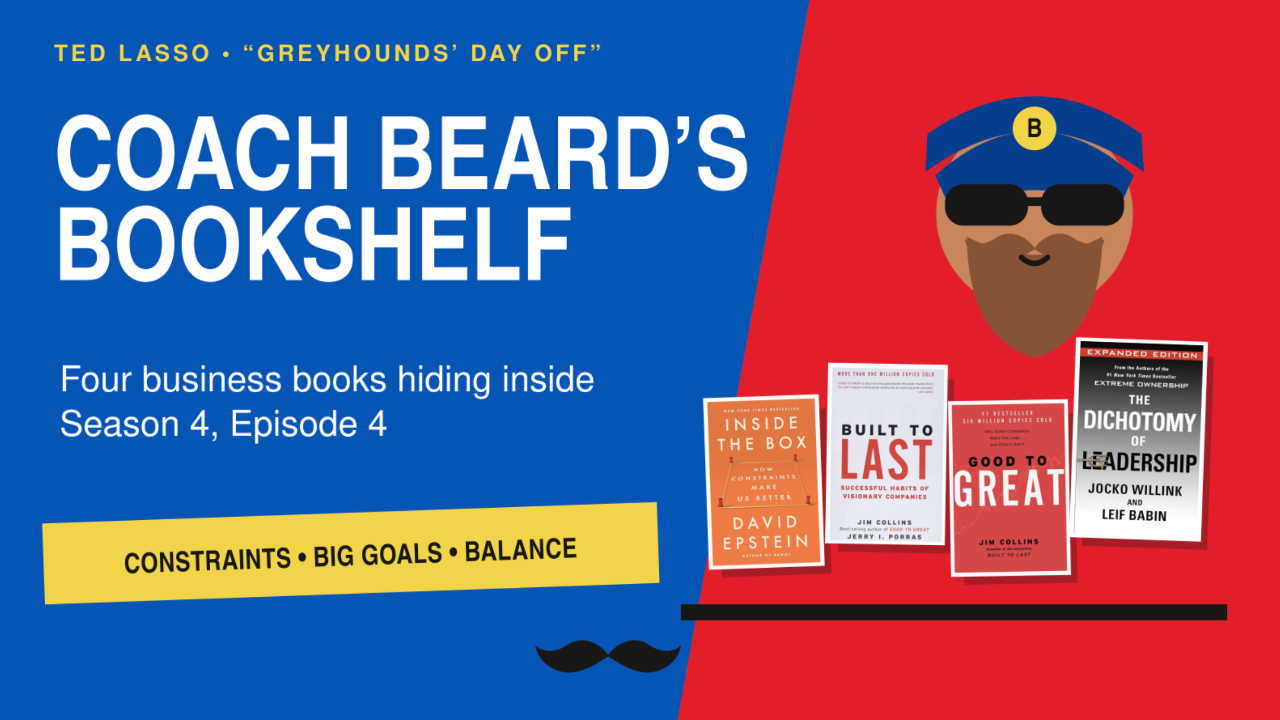
The business books hiding inside Ted Lasso’s lesson on constraints, impossible goals, and a team-building exercise that ends in jail
Spoilers ahead for Ted Lasso, Season 4, Episode 4.
In Lead It Like Lasso, we created Beard’s Bookshelf because Coach Beard has the unmistakable energy of a man who has read the assigned book, the books in the bibliography, and one banned book he found more useful than all of them.
Season 4’s “Greyhounds’ Day Off” practically restocks the shelf for us.
Keeley thanks Rebecca for saying no. Then Keeley announces that Richmond Women will sell out Nelson Road. Meanwhile, Ted attempts to break up the team’s cliques with a pub quiz, and the resulting display of unity ends with everyone in jail.
It is not a conventional leadership curriculum. (Most HR departments prefer the jail portion remain hypothetical.) But underneath the comedy, Episode 4 is wrestling with three serious questions:
- When does a constraint make us more creative?
- When does an impossible goal make us more capable?
- When does a team become so unified that it needs a reminder not to behave like a mob?
For those questions, Beard’s shelf has exactly the right books.
1. Inside the Box: The “no” that makes Plan B better
On Beard’s shelf
Inside the Box: How Constraints Make Us Better by David Epstein
When Rebecca pushes back on Zelda Southport, Keeley does something that might surprise anyone who has ever left a meeting muttering about “leadership’s lack of vision.”
She appreciates the no.
Rebecca’s objections, Keeley explains, make her rethink the problem and find a better approach.
This is David Epstein’s Inside the Box in very fashionable boots. Epstein argues that complete freedom is not always the creative paradise we imagine. Sometimes it is an empty whiteboard and 47 people asking, “What do you think?”
A useful constraint gives the mind something to push against.
The key word is useful.
There is a difference between a wall and a boundary. A wall says, “Stop.” A useful boundary says, “Not that way. What else have you got?”
Rebecca does not solve the problem for Keeley. She does not grab the marker and turn the meeting into a one-woman masterclass. She introduces resistance, and Keeley keeps ownership of the answer. (Even if she just felt like she was just saying no - a lot.)
That is why the no can produce something better instead of merely producing resentment.
Leaders often say they want innovation, then assume their job is to remove every limitation. More budget. More time. More people. More options.
Occasionally, that helps.
Occasionally, it produces more meetings about meetings..
The stronger move may be to define the box:
- We cannot spend more. What could we simplify?
- We cannot add headcount. What work should stop? (This can be the hardest.)
- We cannot use the obvious channel. Who are we failing to reach another way?
- We cannot do everything. What matters enough to survive the cut?
A good constraint does not make the challenge smaller. It makes the thinking sharper.
There is one warning label here. A leader cannot simply say no, offer no context, and later claim to have been stimulating innovation.
That is not Inside the Box. That is just someone sitting on the lid.
Rebecca’s no works because Keeley still has room to move. The boundary is firm; the thinking inside it is hers.
The bookshelf question: Are we giving people enough freedom to create and enough constraint to begin?
2. Built to Last, Good to Great, and the audacity of selling out Nelson Road
On Beard’s shelf
Built to Last and Good to Great by Jim Collins and coauthors
With a useful assist from The Science of Scaling by Benjamin Hardy and Blake Erickson
At the end of the episode, Higgins announces that Richmond Women will play Chelsea at Nelson Road. Keeley immediately tells Rebecca they will sell it out.
There it is: Ted telling Rebecca they are going to “win the whole thing,” only now the impossible promise has a terrific outfit and a marketing plan.
Jim Collins would call selling out Nelson Road a BHAG: a Big Hairy Audacious Goal. The idea comes from Built to Last.
A real BHAG is vivid enough to organize people.
“Grow awareness” is not a BHAG.
“Have a successful match” is not a BHAG.
“Sell every seat in Nelson Road” has a finish line. Everyone knows what winning looks like, including the person counting the empty chairs.
But a BHAG is not optimism screaming from Rebecca's owner's box.
That is where Good to Great adds the necessary tension. Collins’s Stockdale Paradox asks leaders to hold two ideas at once: maintain faith that they will prevail and confront the brutal facts of the present.
Keeley supplies the faith. Rebecca, Alice, and the realities of launching a women’s team supply the facts.
Richmond needs both.
Faith without facts becomes a poster.
Facts without faith become an extremely well-researched reason not to try.
The Science of Scaling takes the idea one step further. Benjamin Hardy and Blake Erickson argue that an apparently impossible goal can reveal which parts of the current model must change.
The value of the goal is not just motivational. It is diagnostic.
If Richmond Women set a modest attendance target, they can probably improve what they are already doing: another announcement, another ticket offer, another polite request to please support the club.
Selling out Nelson Road forces different questions.
Who must care who does not care yet? What would make the match feel unmissable? Which partnerships suddenly matter? What story could travel beyond existing fans? What would have to be true for thousands of people to decide they belong in those seats?
That is the difference between doing more and designing differently.
An impossible goal should not merely demand heroic effort from the same system. It should expose why the old system cannot get us there.
Otherwise, “audacious” becomes a very flattering word for “understaffed.”
This is why Keeley’s declaration matters even before we know whether she succeeds. She changes the scale of the problem.
Nelson Road is no longer just a larger venue. It is the design brief.
Ted does the same thing when he promises to win the whole thing. He is not offering Rebecca a forecast. He is giving Richmond a horizon.
Once the destination changes, different choices become possible on the way there.
Of course, an audacious goal still needs a flywheel, another Collins idea: small, consistent actions that build momentum until the result looks sudden to everyone who missed the work.
Keeley cannot hashtag her way to a sellout. She needs the repeated, less glamorous choices that turn attention into attendance and attendance into allegiance.
The declaration starts the story.
The system has to finish it.
The bookshelf question: Is our biggest goal simply asking the current system to work harder, or forcing us to build a better system?
3. The Dichotomy of Leadership: Team building, but make it legally complicated
On Beard’s shelf
The Dichotomy of Leadership by Jocko Willink and Leif Babin
The Greyhounds have separated into attacker, midfielder, and defender cliques.
Each group makes sense. People gravitate toward colleagues who share their work, language, and view of the field. Cliques are not automatically evidence of bad culture.
Often, they are evidence that belonging has formed somewhere.
The trouble begins when somewhere becomes the only place it forms.
Ted’s solution is to mix the groups for a pub quiz. It is team building with a specific purpose: create new combinations, give people a reason to depend on someone outside their usual corner, and let a different team story begin.
Then taunts trigger a bar fight. Soon the players and coaches are in jail, newly united as one “giant cluster clique.”
Beard supplies the correction: “It’s called a team, coach.”
Heartwarming? Yes.
Replicable? Legal would like a word.
This is why The Dichotomy of Leadership belongs in the episode. Jocko Willink and Leif Babin argue that leadership lives in the balance between qualities that look contradictory.
Leaders must be confident but not arrogant, disciplined but not rigid, aggressive but not reckless, willing to lead and willing to follow.
Episode 4 is full of those balances:
- Rebecca challenging Keeley: Protect the organization without smothering initiative.
- Keeley promising a sellout: Hold audacious faith while facing inconvenient facts.
- Ted mixing the pub-quiz teams: Design the experience, then let people form their own connections.
- The team defending one another: Build fierce belonging without abandoning judgment.
- Ted’s plan ending in jail: Prepare deliberately and adapt when reality tears up the agenda.
Team building itself contains a dichotomy.
It is often treated as fluff because bad team building is fluff: manufactured vulnerability, competitive balloon architecture, and an afternoon during which everyone is quietly answering email beneath the table.
Real team building is not an activity category. It is the work of creating shared history, mutual knowledge, and trust people can draw on later.
Ted understands that the players will not become one team because he delivers a moving speech about unity. They need to experience one another differently.
The mixed pub-quiz groups disrupt the old pattern. The confrontation gives them a common cause. Jail gives them a story they will presumably tell for years, once counsel approves the wording.
But the episode also gives us the part that many culture conversations skip:
Cohesion is an accelerant, not a moral compass.
A tightly bonded team can collaborate faster, recover sooner, and carry one another through hard work.
It can also make a terrible decision with remarkable coordination.
Strong culture gets things done faster. It does not automatically make those things wise.
A team willing to fight for one another still needs leaders who know when “fight for one another” should not involve actual fighting.
Belonging must be paired with accountability. Loyalty must leave room for dissent. Trust should help someone say, “I am with you, and we are absolutely not doing that.”
That may be the most useful dichotomy in the episode.
The goal is not to create people who always move together. It is to create people who care enough to keep one another from moving together in the wrong direction.
The bookshelf question: Have we built a team that will stand up for one another and speak up to one another?
The books work better as a system
The cleverest part of “Greyhounds’ Day Off” is that none of these ideas works particularly well alone.
Constraints without an audacious goal can make people efficient at something unimportant.
An audacious goal without constraints can become an expensive wish.
Cohesion without balance can turn a team into a very supportive bad-decision machine.
Put them together and the leadership architecture becomes clearer:
- The constraint gives us an edge. It tells us where we cannot go and forces us to notice paths we overlooked.
- The impossible goal gives us a horizon. It makes incremental thinking insufficient and reveals what must be redesigned.
- The dichotomy keeps us out of the ditch. It reminds us that nearly every leadership strength becomes a liability when we use it without its balancing force.
This is the kind of leadership thinking Ted Lasso does best.
The show rarely hands us a clean model with arrows and tasteful blue boxes (pink boxes with biscuits, however, yes). It gives us people trying to lead while loyalty, ambition, fear, ego, care, and occasionally law enforcement complicate the diagram.
That is also why the lessons stick.
Leadership does not happen in the tidy space between two book covers. It happens when Rebecca says no, Keeley refuses to hear “never,” Ted rearranges the room, and Beard recognizes a team in a holding cell.
Beard would read all five books. Ted would probably mishear BHAG as the name of a large swamp animal, build a metaphor around it, and somehow make the point more memorable.
We would save him a seat at Nelson Road.
Which book would you slide onto Beard’s shelf after this episode?
Marnie Stockman and Nick Coniglio are the authors of Lead It Like Lasso, a leadership book about finding your purpose, building your team, and creating the kind of culture people want to belong to.
Further reading
- David Epstein, Inside the Box: How Constraints Make Us Better
- Jim Collins, BHAG and the Stockdale Paradox
- Benjamin Hardy and Blake Erickson, The Science of Scaling
- Jocko Willink and Leif Babin, The Dichotomy of Leadership
- Vulture, Ted Lasso recap: “Greyhounds’ Day Off”
Stay connected with news and updates!
Join our mailing list to receive the latest news and updates from our team.
Don't worry, your information will not be shared.
We hate SPAM. We will never sell your information, for any reason.
